
Silver Spring City Directory Collections
Montgomery History's Jane C. Sween Research Library holds the most concentrated set of city directory volumes for Silver Spring. Its Silver Spring Historical Society finding aid maps what sits on the shelf. The runs are not one continuous annual chain. Nelson's Washington Suburban volumes give way to Polk's suburban series. Then come Polk titles naming Silver Spring directly. Finally, the collection ends with community phone books. Gaps in that sequence describe the collection, not the town. A household missing from one year may simply have gone unlisted. Appointments are required to use the non-circulating books. The online catalog is worth a search ahead of any visit for related files.
| Collection | Years | Where held | Access |
|---|---|---|---|
| Nelson's Washington Suburban Directory | 1912, 1916-1918, 1923 | Montgomery History / Sween Library | Bound volumes; research appointment |
| Polk's Washington Suburban Directory | 1927-1928, 1930-1931 | Montgomery History / Sween Library | Bound volumes; research appointment |
| Polk's Silver Spring City Directory | 1954, 1960, 1962, 1964, 1966, 1968, 1969, 1971, 1973 | Montgomery History / Sween Library | Bound volumes; research appointment |
| Silver Spring Community Phone Book | 1995-present | Montgomery History / Sween Library | Bound collection; listing rules vary |
Start with the Silver Spring directory finding aid to pin down a title and a year. It points to two local newspapers as well. The Maryland News ran from 1928 through 1975. The Silver Spring Standard ran from 1939 through 1946. A directory line may suggest a move, a death, or a community tie. Those claims can often be tested against the newspaper pages. Pairing the street directory with the newspaper record gives a claim two independent anchors. Note: A directory is a snapshot of one edition, not proof that every person at an address was listed that year.
Silver Spring Directory Years and Growth
Silver Spring's printed trail grew with the community rather than out of a city-clerk system. The place was never incorporated. It sits in Montgomery County as an unincorporated community. The earliest historical run is a 1912 suburban directory. County histories credit E. Brooke Lee's 1921 subdivision of 19 acres with kicking off real growth. Polk suburban volumes follow in the late 1920s and early 1930s. The first volume titled Polk's Silver Spring City Directory carries a 1954 date. Community phone books only begin in 1995.
| 1912 | Located Nelson suburban directory volume predates the 1921 subdivision milestone. |
|---|---|
| 1927-1931 | Located Polk Washington Suburban volumes document the interwar suburban network. |
| 1954 | First specifically titled Polk's Silver Spring City Directory found in the holding list. |
| 1995-present | Located Silver Spring Community Phone Book run begins, with coverage that may depend on subscription or community listing practices. |
That timeline is itself a records story. It explains why one family can appear under a suburban label in one era. The next era may attach a Silver Spring label instead. Postal, planning-area, and census-place labels each carry their own meaning. Keep them separate in your notes rather than quietly merging them. That preserves what the street directory actually recorded.
Silver Spring City Directory Place Names
Keep the printed place label when you run a Silver Spring city directory search. Silver Spring is a postal and regional name rather than an incorporated city. One record may say Downtown Silver Spring, Long Branch, Takoma Park, or Lyttonsville. Others may read Four Corners, Montgomery Hills, Eastern Silver Spring, or Takoma/Langley Crossroads. Colesville, White Oak, Wheaton, Aspen Hill, Burtonsville, and Takoma also surface in records. Those place names tie to the wider postal area. Treat those labels as search terms. They are not errors to correct.
Let the street spelling, cross streets, and date be your guide. Together they tell you whether a result belongs to the same household. The Sween catalog rewards separate searches for a street, a surname, and a local name. Its loose handling of "Silver Spring" can pull material matching either word. That can include Sandy Spring or spring-house entries. A quick place check keeps a strong city-directory lead from landing on the wrong neighborhood.
Silver Spring City Directory at Sween Library
The Sween Library is far more than a shelf of city directories. Its local collections hold books, manuscripts, and oral histories. Tax assessments from 1793 to 1865 sit there too. So does Montgomery census material from 1776 to 1900. Family files, Bible records, wills, obituaries, and church material round out the holdings. Cemetery cards and local newspapers fill out the rest. More than 14,000 digitized photographs sit there as well. These companions can turn a directory address into a fuller family-history record. No single listing should stand as final proof on its own.
The Montgomery History collections overview describes the appointment-based reading room. It also covers free in-room access to Ancestry.com, Newspapers.com, and Fold3. McGee Library in Silver Spring offers public computers and referrals. The deeper local-history directory runs, though, live at Sween rather than at McGee.
The Sween Library collections page introduces the local-history holdings behind this Silver Spring city directory research. The reading room covers the families behind each entry.
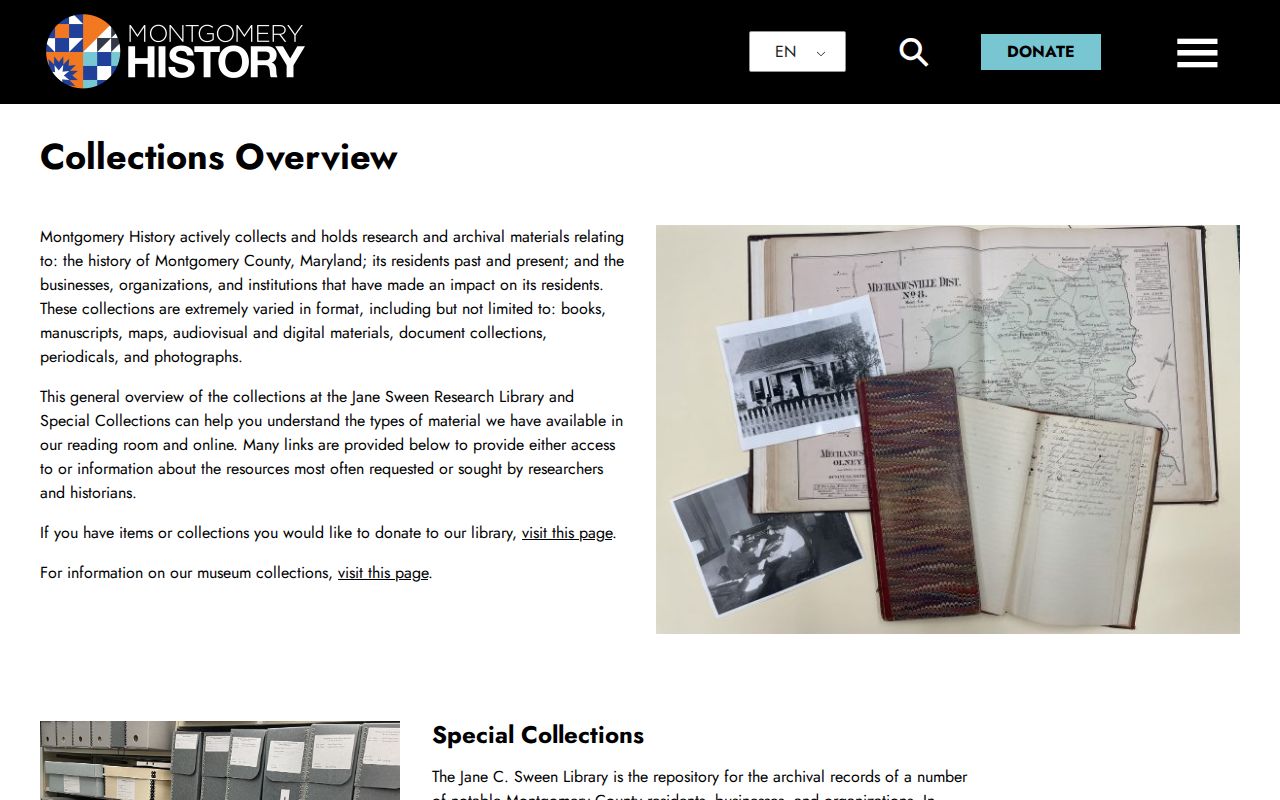
When a directory line ends or a surname takes several spellings, the library's surrounding family, newspaper, map, and cemetery resources earn their keep.
Reading a Silver Spring City Directory Entry
Treat each city directory entry as a record of one edition. A volume may list an alphabetic head-of-household name. It may also list a spouse in parentheses, an occupation, and a business connection. Some lines add a street address, a telephone number, or an owner or renter mark such as h or r. Others carry a widow notation. The Silver Spring finding aid prints no abbreviation key and no page-level sample, so check the volume's own key before expanding any shortened term. Note the publisher, year, and page. Say whether the line came from the alphabetic or street section.
| Printed name | Copy spelling, initials, and relationship wording exactly as printed. |
|---|---|
| Address | Record the house number, street spelling, and any direction or suffix used by that edition. |
| Occupation or business | Use it as a comparison detail, not a substitute for an identity record. |
| Telephone or subscriber mark | Note that phone books may list subscribers rather than all household members. |
| Edition details | Keep the title, publisher, year, page, and section with the transcription. |
- Criss-cross directory
- A directory section arranged by street address, when the volume includes one, used to locate listed occupants before checking their alphabetic entries.
- Householder index
- An alphabetical arrangement centered on a listed household head, rather than a complete roster of everyone in a dwelling.
- Abbreviation key
- The edition's own explanation of marks and shortened words. Photograph or transcribe it before interpreting a notation.
Silver Spring City Directories Online
Digitized Silver Spring city directories save shelf time. Still, the host and the edition shape what you find. Ancestry's U.S. City Directories collection lists Silver Spring material for 1958 and 1960. MyHeritage carries a separate 1960 volume. It covers Silver Spring plus Bethesda, Chevy Chase, Kensington, Takoma, and Wheaton. The Library of Congress holds Washington Metropolitan and Maryland Suburban white and yellow pages. These span 1933-1945, 1963/64, and October 1971-1973. Treat each host as a discovery channel. None of them guarantees full coverage of every year. None covers every past resident of Silver Spring.
For material held locally, PastPerfect puts parts of the Sween Library catalog online. Run separate searches for Silver Spring, Sligo, Takoma, street names, family surnames, and alternate spellings. The search is broad. A query can match either word in the name, pulling in Sandy Spring or spring-house items. Give each result a quick place check.
Inside Ancestry's digitized city directories collection, the page images give a visual route. They lead to the 1958 and 1960 Silver Spring editions identified there.
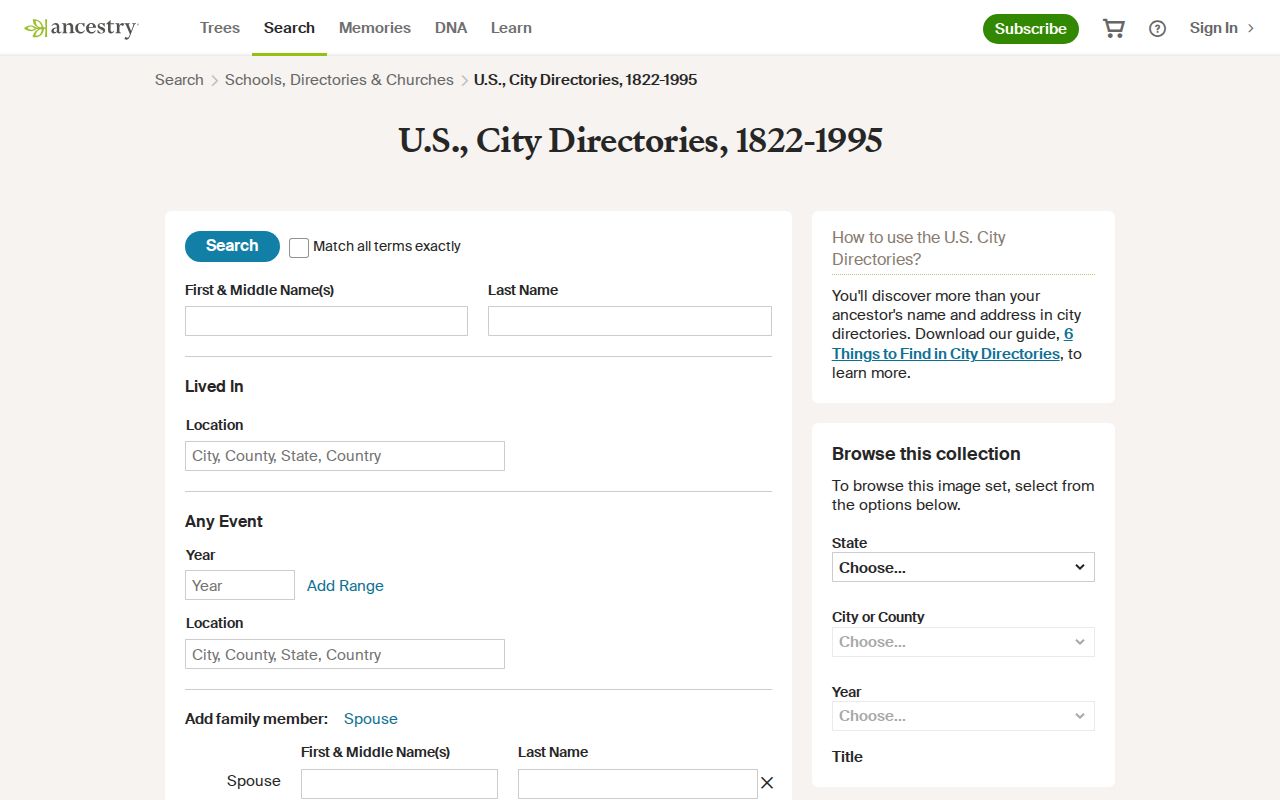
Confirm the publication title and year on the displayed page image first. Only then add a directory entry to a family or address timeline.
Silver Spring City Directory Clues in Print
A single directory line often begs for a second local record. Montgomery History holds the Montgomery County Sentinel from 1855 through 2020. It also holds the Montgomery County Gazette from 1960 through 2015. The Sween Library adds obituary and biographical newspaper files. It also offers church records and cemetery cards from 111 cemeteries and family burying grounds. A dated obituary or a cemetery card can explain a missing household. So can a newspaper item. Any of these may show why a household drops out of the next city directory edition.
These records do different jobs. A cemetery card is a name-indexed local collection. A newspaper supplies a dated event. A city directory supplies a listed address or subscriber detail. Record the source and the date for every item you use. Read the records together rather than assuming a gap in the directory means a move or a death. Do not assume the worst. Cross-checking beats guessing every time.
Note: The 111-cemetery card index belongs to Montgomery History, not to one public database of every Silver Spring burial.
Using Silver Spring City Directories for Family History
Begin family history work with the clearest name-address pair you have. Follow that pair through the nearest directory years you can locate. Normalize abbreviations, but keep the printed street form in your notes. If the volume has a street section, use it. Then compare that result with the alphabetic listing. This catches name variants and other printed details. Keep the historical volumes separate from the modern address trail. The Silver Spring Street Directory covers that modern trail.
- Choose a target name or address and identify the nearest available directory year.
- Transcribe the line with its edition, page, spelling, and section.
- Check the next located directory year and record moves, omissions, or changed spellings.
- Pair a directory observation with the closest public federal census, available through 1950 under the 72-year release rule.
- Use a newspaper, obituary, cemetery card, probate file, or family file to test an apparent endpoint.
A city directory is an annual snapshot, not continuous proof of residence. An absence can mean a missed edition, a non-subscriber, a move, an indexing choice, or a variant spelling. When a historical address needs a present-day records check, turn to the person-focused workflow on the Silver Spring resident lookup page instead of treating an old listing as current.